
This article is adapted from the official Kachaka manufacturer blog by Preferred Robotics, “AGVとAMR:「自動」と「自律」の違いから用途の差まで詳しく解説.” The original text is authoritative; some passages are summarized. The source link appears at the end.
Most people have a rough sense that “AGV” and “AMR” are both robots that move things around—but the two differ in a fundamental way:
- AGV: a vehicle that moves goods automatically by following a “guide,” used mainly in controllable environments such as factories
- AMR: a robot that uses robotics to judge and move on its own—autonomously—even with no guide in its surroundings
What Is an AGV?
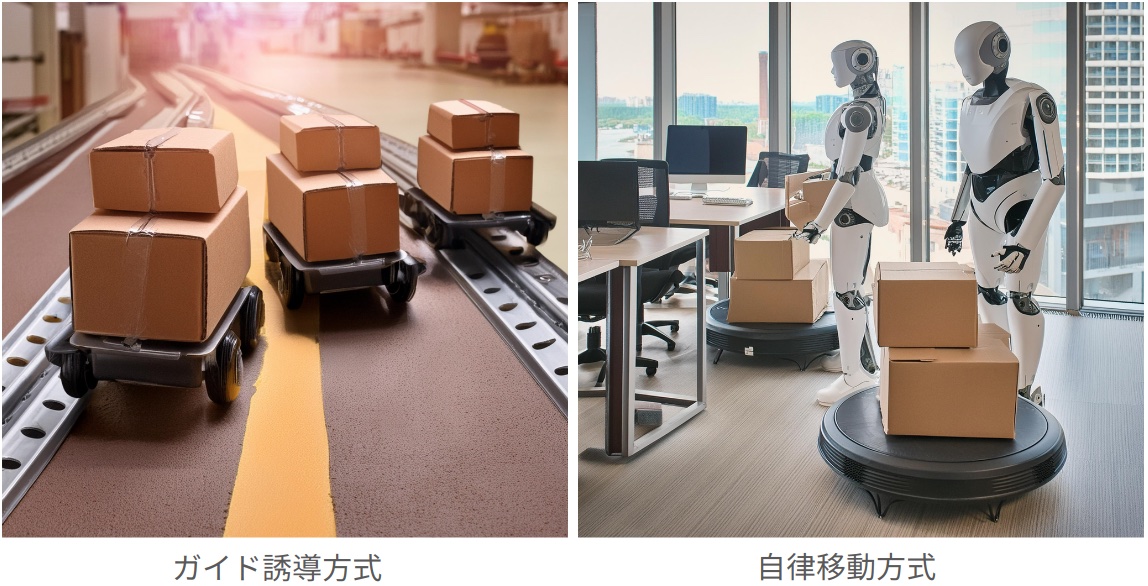
AGV stands for Automated Guided Vehicle. As the name suggests, it requires a guide prepared in advance to tell the vehicle “how to move”—for example, markers placed on walls (the marker method) or lines painted on the floor (the line-following method). The vehicle then uses these guides to automatically determine its position, orientation, and path.
Because guides must be laid out beforehand, AGVs took hold mainly in environments like factories where that installation is feasible—and they were in active service on real factory floors long before AI became widespread. While guidance technology itself has evolved alongside AI advances such as image recognition, the vehicle itself makes few decisions of its own. That is why the “A” in AGV has always stood for Automated, not Autonomous.
Can You Use an AGV to Deliver Food in a Restaurant? No.
Everyday spaces are different from factories. For the sake of appearance, laying out guides in advance is difficult—and a new venue that needs to work “right out of the box” can’t depend on guides at all. The original article jokes that forcing an AGV into a restaurant would mean covering the floor with guide lines until the whole place looked like a factory interior. To take robots out of the factory and have them move goods in settings close to daily life, you have to make the technological leap from “automated” to “autonomous”—and that is exactly what the rapidly spreading AMR delivers.
What Is an AMR?
AMR stands for Autonomous Mobile Robot. Its biggest difference from the AGV is that it can move without relying on a guide. Another distinction: the “V” in AGV is “vehicle,” while the “R” in AMR is “robot.” AMRs are not limited to vehicle form—any mobile, autonomous robot qualifies. A bipedal walking robot, for instance, is one representative type of AMR.
The Fastest-Spreading Type Today: Wheeled AMRs
The fastest-spreading category in recent years is the wheeled AMR. Kachaka, developed by Preferred Robotics, is exactly this form—legless and moving on wheels—as are the food-delivery robots commonly seen in restaurants. The trade-off of wheels is that they cannot clear steps or climb stairs, so they are used mainly in step-free, single-floor spaces. Beyond delivery robots, representative subcategories include cleaning robots, security robots, and digital-signage robots in public spaces such as malls, train stations, and airports.
”Transport” Is the AMR’s Forte Right Now
Among these uses, the original author argues that “moving things” remains the AMR’s most practical value at this stage. The best-known example is Kiva in Amazon’s fulfillment warehouses: the robot docks with a shelf and carries the entire rack to a picker. Today AMRs are in service not just at Amazon but in warehouses of every kind.
Here’s an interesting question: warehouses are like factories in that laying out guides isn’t hard, so why are robots like Kiva usually classified as AMRs rather than AGVs? The answer lies in another key difference—most of an AMR’s added value comes from “software.”
The AMR’s Strength: Flexibility from Software
Behind Kiva sits a sophisticated planning algorithm that orchestrates robots through the warehouse in the optimal way. The warehouse’s physical environment changes little, but “which orders arrive, when, and how many” differs every time—so it calls for a robot that fully leverages AI and can respond “autonomously.” A factory is the opposite: the items and quantities to be produced are mostly scheduled in advance, autonomous behavior isn’t essential, and it’s enough to prevent predictable issues like “hitting a person while driving automatically”—an area where AGV safety design is already quite mature.
An AMR’s software flexibility shows up not only in autonomy but also in user interfaces operated from a phone or tablet. This makes the AMR a key product for extending DX (digital transformation) from online into the physical, offline world: using software to boost operational efficiency and create new value, no longer confined to online processes.
Where Only an AMR Will Do
Following this thread, the division of labor between AGV and AMR comes into focus. Manufacturing increasingly talks about “high-mix, low-volume production” and “mass customization.” Large-scale production still runs on carefully pre-planned processes, but the portion of the line that needs flexible reconfiguration is precisely the stage where the AMR’s autonomy shines—coexisting and collaborating with AGVs.
From a service standpoint, the AMR sits squarely in the middle ground between “machinery: standardized and highly efficient, but inflexible” and “human labor: individualized and highly flexible, but inefficient”—much as ticket machines and automatic fare gates took over the ticket-punching that station staff once did by hand. In a society facing falling birth rates, an aging population, and ever-worsening labor shortages, service robots like AMRs will fill the gaps that conventional automation can’t reach, raising efficiency without lowering service quality.
A Kachaka Case Study
The original article closes with a Kachaka deployment: Allied Telesis automates network-equipment quality testing with robots. The AMR replaced long-distance transport testing that had been done by hand—and because the robot never tires, it handles a greater workload than before. This work takes place in an office, not a factory, where guides cannot be laid out, so “autonomous movement” is a hard requirement. It is a textbook scenario where only an AMR will do and an AGV simply can’t.
Source: Preferred Robotics — AGVとAMR:「自動」と「自律」の違いから用途の差まで詳しく解説 (kachaka.life). All rights to the original text and images belong to Preferred Robotics; this is an attributed, adapted introduction.