
FUJIFILM Manufacturing Kachaka Deployment Case Study | Automating PWB Magazine Transport
FUJIFILM Manufacturing Corporation
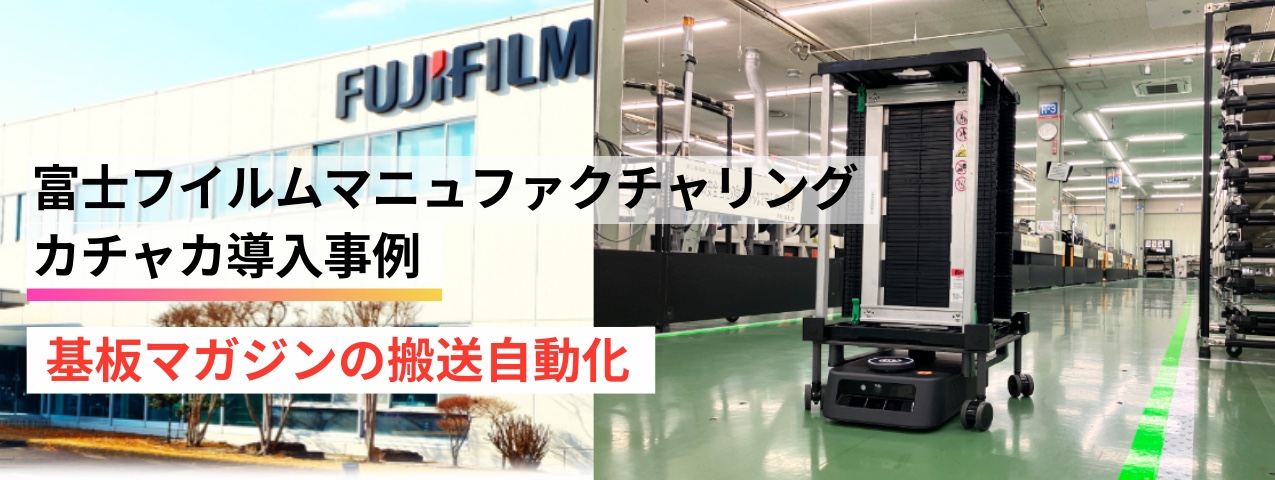
Preferred Robotics, Inc. (headquarters: Chiyoda-ku, Tokyo; President and CEO: 礒部達) announced that FUJIFILM Manufacturing Corporation (headquarters: Ebina, Kanagawa) has deployed the autonomous transport robot “Kachaka” at its 鈴鹿事業所. This article covers the challenges and background that led to the deployment, along with how it is being used in practice.
The Challenge Before Deployment
The plant had relied on operators known as “water spiders” (mizusumashi) to handle transport and various other support and prep tasks. The entire SMT (Surface-Mount Technology) process floor was staffed by 2 water spiders who, in addition to transport, also handled parts supply and similar duties.
A study of this work revealed that roughly 28% of daily labor hours were spent on “magazine transport”—a clear opportunity for efficiency gains. To automate as much of this work as possible, the plant began evaluating AMRs (autonomous mobile robots).
Why Kachaka Won: Compact, Affordable, API-Extensible
After being introduced to it by an acquaintance, the company discovered Kachaka online and reached out to the manufacturer, Preferred Robotics. Among the many transport robots available, Kachaka was ultimately chosen for its “compact size” that allows it to work alongside people, its “affordable price,” and its “intuitive operability”—and, just as importantly, because its “open API enables integration with in-house applications.” On that basis, the company concluded it could be deployed on the floor without added burden.
How It Is Used Today: Automated PWB Magazine Transport
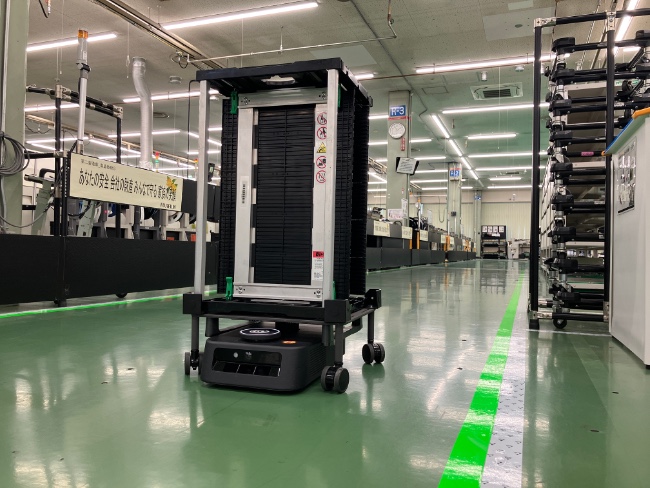
A total of 2 Kachaka units are now in operation across the SMT process. Transport commands are issued from a PC by an in-house-developed application via the Kachaka API. In practice, a magazine loaded with pre-production PWBs (printed wiring boards) is placed on Kachaka and transported to the start of the SMT process. Each round trip covers about 30 meters, and the units run roughly 3 hours per day (per shift).
In actual use, the takeaways were clear: initial setup was intuitive enough that no manual was needed, and operation via the app or buttons was simple. Post-deployment support was thorough, allowing the team to operate with confidence. On safety, the obstacle-avoidance function meant there were no issues in operation.
In addition, because the API is open, integration with in-house applications enabled the following capabilities:
- Safety: warning lights installed in aisles (synchronized light/melody alerts)
- Operation: transport commands issued from an in-house-developed application (both Unit 1 and Unit 2 can be dispatched automatically)
- Function: after a magazine transport is complete, the robot returns to its home position automatically via camera recognition
The Results: Automating 3 Hours of Daily Transport
Since deploying Kachaka, roughly 3 hours of transport work per day (per shift) has been automated, sharply reducing staff walking. With the water spiders’ workload eased, they can now focus on higher-value-added work, delivering both labor-hour savings and improved production efficiency. Work standardization continues to advance, with safety and operational stability improving in step.
With a clear return on investment confirmed, the company plans to add 2 more units to the inspection process in the near term, on top of the 2 currently in service, and is evaluating expansion to other processes. For the additional 2 units, deployment is being assessed with further attention to operator convenience, including issuing commands via buttons.