
Autonomous Transport Robot "Kachaka Pro" Paired with Powerless "Karakuri" Mechanisms Eliminates Manual Hauling Entirely | DENSO Corporation 高棚製作所 Case Study
DENSO Corporation, 高棚製作所
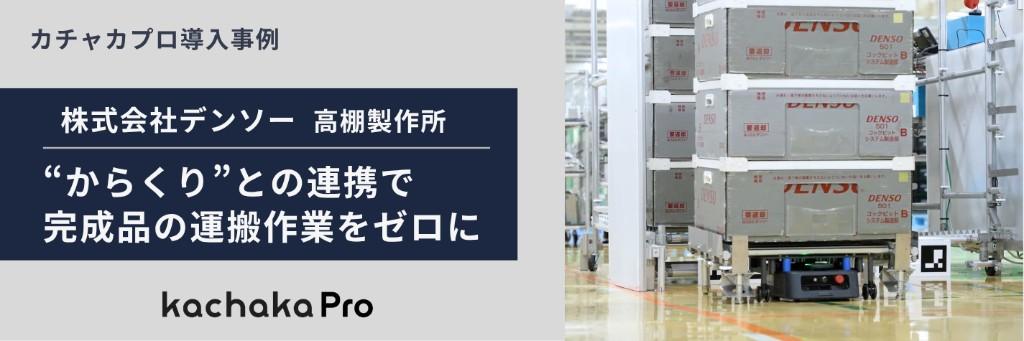
Preferred Robotics, Inc. (Headquarters: Chiyoda-ku, Tokyo; Representative Director and CEO: 礒部達) has deployed its autonomous transport robot “Kachaka Pro” at the 高棚製作所 of DENSO Corporation (Headquarters: Kariya City, Aichi Prefecture). This article covers the challenges behind the deployment and how Kachaka Pro is being used today.
The Company: DENSO Corporation, 高棚製作所
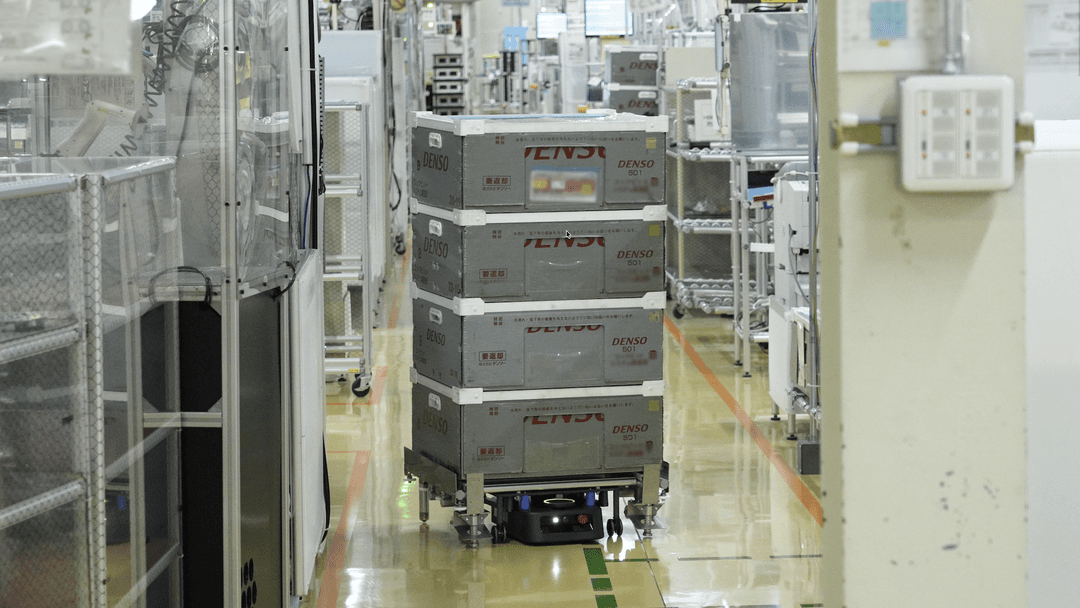
DENSO is a world-class automotive components manufacturer, supporting the global auto industry with its long history and technical strength. The 高棚製作所 primarily produces a diverse range of in-vehicle parts—including speedometers, displays, and various sensors—supplying high-quality products worldwide through an efficient production system and the adoption of the latest technologies. The plant deployed Kachaka Pro across 4 production lines to automate finished-goods transport and packaging-box collection.
Background: Streamlining a “Simple but Heavy” Hauling Task
The 高棚製作所 runs high-mix, low-volume production and handles a vast range of parts. To deliver the right parts to the line at the right time, the team had long been searching for ways to improve efficiency. Their focus was on reducing simple yet physically demanding work, building a floor where “people concentrate on the tasks only people can do.” Among these, hauling finished goods—though simple—placed a heavy physical burden on workers due to the weight, so they continued to seek automation for the task.
The challenge was that the plant’s aisles were narrow and the line layout could not be easily changed—they wanted to pursue automation but struggled to move it forward, a problem they had faced for years. On top of that, conventional factory AMRs are expensive, large, and powerful; requirements such as installing safety fencing made them effectively impossible to run in the plant’s narrow aisle widths. “We wanted to use one, but we couldn’t” was the frustration at the time.
Why They Chose the Autonomous Transport Robot “Kachaka Pro”
When evaluating transport robots, three reasons stood out for choosing Kachaka Pro:
The only option that could run in narrow aisles: While searching online for an AMR with a small turning radius, the team learned that Kachaka Pro already had a track record in tight environments such as clinics. The lead admitted to initial skepticism—“it’s much smaller than I imagined; can it really do the job?”—but it was precisely this compact size that allowed it to run smoothly through the existing narrow aisles, making it “the only option.”
Flexibility that fits the floor: No line-layout changes were required, and rerouting was easy. Kachaka Pro’s high maneuverability was a perfect match for the floor.
The safety needed to work alongside people: Because this is a floor where robots and people work side by side, safety was a key concern. Kachaka Pro’s low thrust means there is no risk of injury even on contact, so no safety fencing is required. Its approachable design—friendly even to those unfamiliar with AMRs—was also an important factor in the decision.
How It’s Used: Combining “Karakuri” Mechanisms to Automate Even the Transfer
Kachaka Pro is responsible for “transporting finished goods to a designated drop-off zone (outbound)” and “retrieving the packaging boxes needed for the next production run and supplying them to the line (return).”
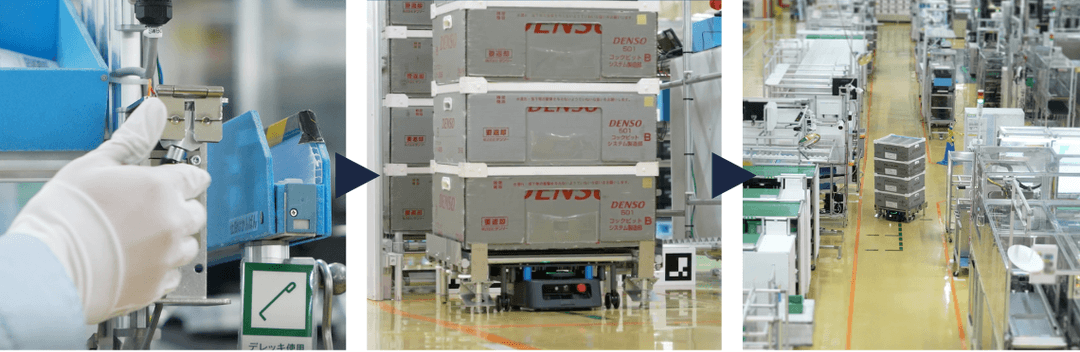
Previously, a single round trip meant hauling boxes weighing nearly 30 kg an average of 22 meters—a heavy burden. After deployment, the worker simply places the finished goods onto Kachaka Pro and presses a switch, dramatically reducing the physical load.
Highlight: Co-developing Powerless “Karakuri” Mechanisms with the Manufacturer
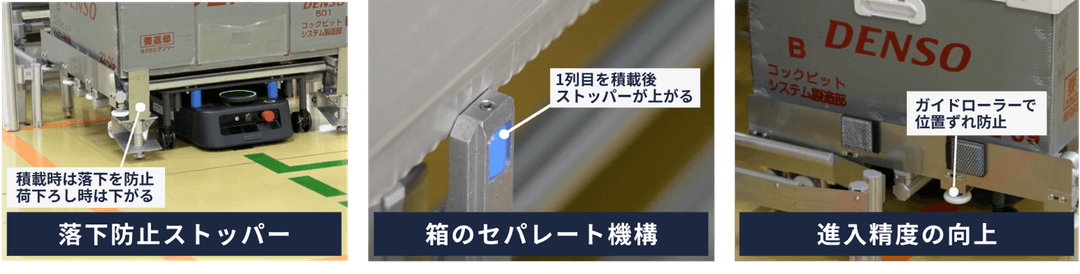
The most distinctive part of this automation flow is that, to maximize the value of Kachaka Pro, DENSO co-developed powerless “karakuri” (mechanical mechanisms requiring no electricity) with manufacturer Preferred Robotics to automatically transfer and load the boxes. This “karakuri” set centers on three clever designs:
- A drop-prevention gate during transport: The gate lowers only the moment Kachaka Pro arrives at the drop-off zone, releasing the box; once the robot departs, spring force raises the gate again automatically.
- A box-separation mechanism: As the robot arrives at the packaging-box zone and releases the zone’s gate, it controls the first and second rows of boxes so they do not flow out together.
- Improved entry accuracy: To prevent positional misalignment when entering the drop-off zone, guide rollers were added so the robot follows the guides and seats itself precisely. This eliminates instability on entry, pursuing a mechanism that is failure-free, safe, and low-cost.
Results: Finished-Goods Hauling Eliminated, Selected as a 2025 Manufacturing Division Topic
The biggest result after deploying Kachaka Pro is that the high-load task of hauling nearly 30 kg boxes was completely eliminated. What used to mean an average 22-meter trip per haul, 58 trips a day—roughly 2,000 steps of manual labor—now takes a single press of a switch. Workers reported that “the job has genuinely gotten easier,” and the floor felt the value of the deployment firsthand. The project was also selected as a 2025 Manufacturing Division Topic, drawing significant internal recognition as a successful example of AMR adoption.
Looking Ahead: Expanding to 11 Lines and Scaling Across Departments
The team is now evaluating expansion from the current 4 production lines to 11, along with applications beyond finished-goods transport. These results have already been shared with other manufacturing departments and group companies across 10 sites—crossing departmental boundaries and scaling implementation laterally across the floor.
Summary: “Kachaka Pro” Driving Transport Automation at the DENSO 高棚製作所
The decisive factor in DENSO 高棚製作所’s choice of Kachaka Pro was its high maneuverability—the ability to run in existing narrow aisles and operate flexibly without any layout changes. With these qualities, Kachaka Pro is exceptionally compatible with manufacturing floors and is well worth considering when driving transport automation. And as this case shows with the co-developed “karakuri” mechanisms, customized collaboration is also possible.